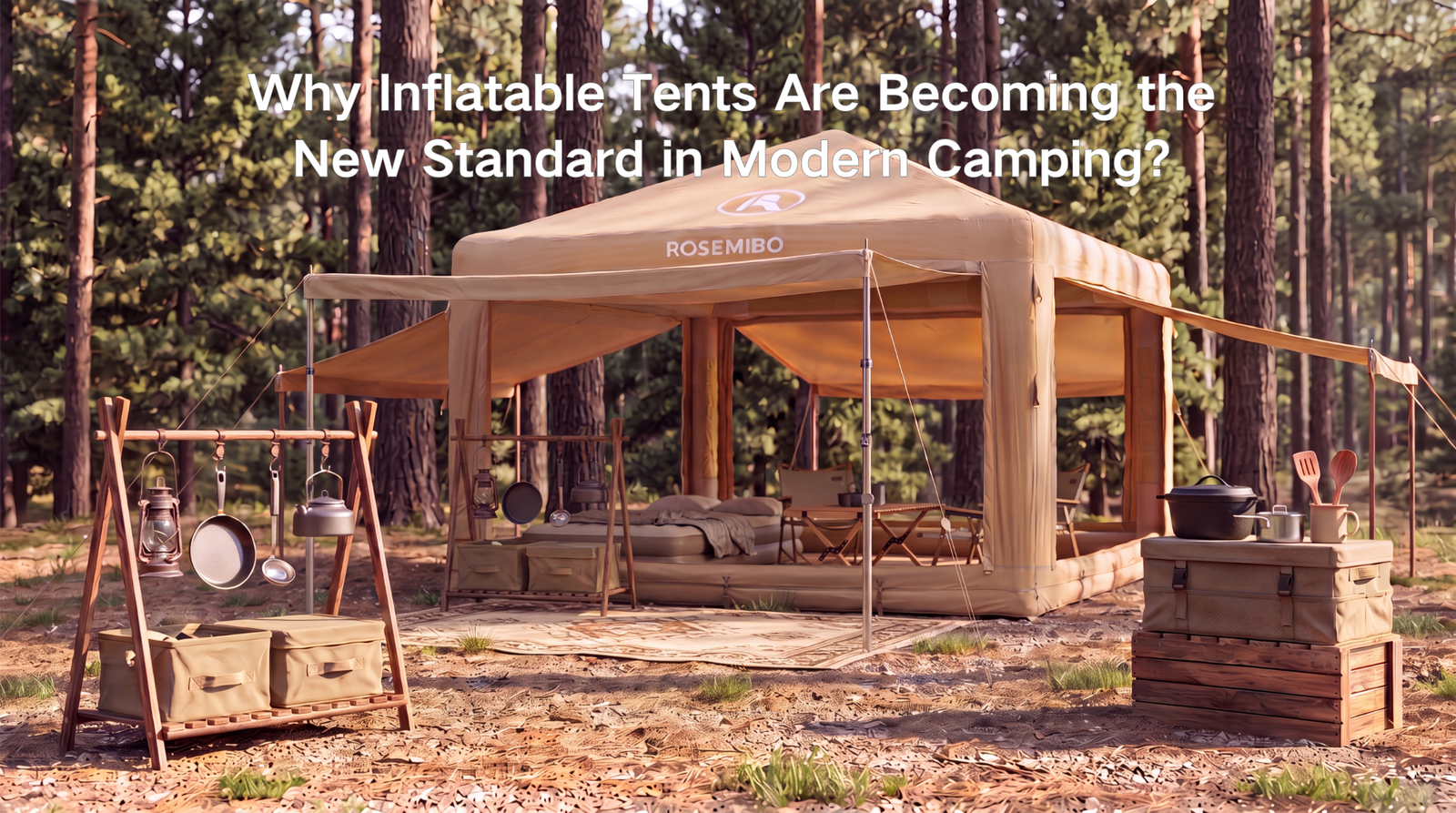
Why Inflatable Tents Are Becoming the New Standard in Modern Camping?
A decade ago, camping brought to mind a solitary hiker shouldering a pack, climbing ridges, pitching a compact tent, and quietly watching the sunrise. Today, that image has given way to something entirely different—groups of friends or families gathered around an inflatable tent, sharing meals, laughter, and the joy of the outdoors. What triggered this transformation? And why have inflatable tents become the preferred choice for so many campers? Let’s examine the drivers behind this shift from three key angles.
The Camper Profile Has Shifted – From Hardcore Trekkers to Family-Oriented Experience Seekers
In any industry, product evolution mirrors changes in the user base. In the early days, outdoor camping was dominated by hardcore backpackers and trekking enthusiasts—users who prioritized minimal weight and compact pack size above all else, often sacrificing comfort to shave off every possible gram.
Today, the core consumers of camping gear are a diverse group:road-trip families, casual beginners, “glamping” movers who bring substantial gear, and commercial campsite operators. While weight still matters to them, they are far less rigid about it. As long as the weight delivers tangible value—in comfort, space, or durability—they are willing to embrace it. This is precisely where inflatable tents, with their superior livability, have found their place.
The majority of our customers are experience-driven campers. Some rent long-term campsites and purchase inflatable tents to enjoy extended stays in nature. Others are new camping families who, with our guidance, set up their first inflatable tent step by step and can’t wait to share their outdoor moments. These real-world cases all point to the same trend: inflatable tents are steadily going mainstream, gaining widespread acceptance among family-oriented camping enthusiasts.
Continuous Material and Functional Upgrades Have Gradually Proven Their Superiority in Extended Camping Scenarios
Over the past few years, the frequent setup and takedown of inflatable tents has provided invaluable field data for manufacturers, driving rapid product improvements. The fabrics used in inflatable tents, in particular, have undergone four distinct evolutionary phases in a short time:
Phase 1 – The Embryonic Stage: Early inflatable tents used low-denier polyester oxford with a single-sided PU coating. Fabric density and abrasion resistance were minimal—easily snagged or torn by branches and rocks. Waterproofing was basic, and the complete lack of breathability led to severe condensation buildup inside the tent.
Phase 2 – Early Recreational Adoption: Fabrics were upgraded to 420D/600D high-density polyester oxford, offering improved tear strength and outdoor abrasion resistance. UV-reflective properties achieved UPF 50+ sun protection. However, the material remained fully synthetic, so breathability issues persisted, and condensation continued to be a noticeable problem.
Phase 3 – The Recreational Camping Boom: Standard TC (polyester-cotton) blended fabrics began to see widespread use. These materials effectively regulate internal moisture, significantly reducing condensation—a long-standing pain point for campers. Temperature control also improved notably, making them better suited for overnight and extended family stays. That said, early-generation TC fabrics had clear limitations: inadequate waterproofing under prolonged heavy rain, moisture absorption leading to increased weight, and limited resistance to mildew and UV degradation.
Phase 4 – Precision Refinement: Upgraded TC Tech-Cotton fabrics were developed. Through water-repellent treatments, optimized blend ratios, and advanced finishing processes, manufacturers addressed the key shortcomings of earlier TC materials—water penetration, excessive moisture uptake, and slow drying. At the same time, fabric weight was reduced, while UV resistance, anti-mildew properties, and overall weather resistance were significantly enhanced. When paired with ripstop oxford base layers in various specifications, these materials now serve a broad spectrum of use cases—from quick weekend trips to full-scale family camping and long-term campsite operations—cementing the inflatable tent’s position as a market leader.
Today’s TC Tech-Cotton inflatable tents have moved well beyond the limitations of earlier generations. They have become the standout choice in the premium camping segment, delivering the breathable, temperature-regulating comfort that defines the TC advantage. The sticky, suffocating heat and condensation-drenched interiors of synthetic tents are now a thing of the past. Daytime camping stays fresh and airy; nights are warm, dry, and comfortable—making these tents truly suitable for four-season use. In addition, the fabric resists sun damage, mildew, and aging, standing up to repeated setup and teardown as well as extended campsite installation without premature wear. The result is a significantly longer service life.
Superior Adaptability to Harsh Environments Is the Core Advantage That Propels Inflatable Tents Ahead of Traditional Pole-Supported Models
Traditional tents with fiberglass or aluminum poles rely on rigid structural frames. While adequate in mild conditions, these hard-point systems have very low tolerance for high winds, severe temperature swings, or uneven terrain. Stress concentrates at joint and pole points, making them prone to bending, splintering, or deformation. Once a pole fails, the entire tent loses its integrity and can no longer withstand wind or rain—leaving campers vulnerable in sudden weather changes.
Inflatable tents, by contrast, leverage a proven air-beam architecture combined with advanced technical fabrics to form a flexible, resilient defense system. The air columns distribute forces evenly across the structure, absorbing and dissipating wind loads through controlled flexibility rather than rigid resistance. This dynamic, flexible response eliminates the risk of brittle fracture—delivering significantly greater stability and safety in adverse weather compared to traditional pole-supported tents.
F A Q
TC Tech-Cotton fabrics are treated for UV resistance, anti-mildew protection, and anti-aging performance, offering outstanding weather resistance and durability. Combined with the air-frame design—which eliminates pole fatigue and breakage risks—these tents, with normal care, far outlast standard polyester or older TC tents, making them a reliable choice for years of regular use or long-term campsite installation.
No. The upgraded TC Tech-Cotton features an advanced water-repellent finish and optimized construction that resists water penetration. It absorbs minimal moisture and does not become significantly heavier when wet, ensuring consistent, dependable performance even during extended rainy weather.
It is slightly heavier than ultralight alternatives—but that extra weight translates directly into greater stability and long-term durability. The heavier, more substantial fabric offers superior wind resistance and ruggedness, and since these tents are designed for vehicle-based camping (not backpacking), they are not meant to be carried on foot. One person can easily transport, lift, and set up the tent without assistance, making it entirely manageable for solo users.